
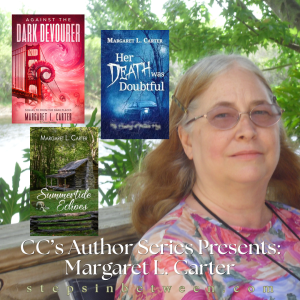
CC’s Interview Series: Author, Margaret L. Carter
I had the pleasure of meeting a co-author from the young adult Haunting of Pinedale High series, published by the Wild Rose Press. We live on opposite sides of the US. She lives in Maryland and I live in Washington State, but the wide world of social media and the Internet brought us together.
Her book in our stand-alone series is Her Death was Doubtful and mine is When June Haunts May, but where we differ is she’s been writing books for far longer! Come learn about this creative in our interview below!
CC: Introduce yourself to our readers and tell us how long you’ve been writing?
Margaret L . Carter: I hold degrees in English literature from the College of William and Mary, the University of Hawaii, and the University of Maryland (Irvine). I’ve taught a few college classes part-time over the years, but my only long-term job was as a contractual proofreader/editor for the Maryland General Assembly. My husband and I retired from his thirty-year Navy career to Annapolis, Maryland, where we live now. I started writing at the age of thirteen, on an old manual typewriter my aunt had left behind in my grandparents’ house. I write paranormal romance, fantasy, and horror, plus nonfiction on vampirism in literature.
CC: What sparked your initial interest in writing? Or how did it find you?
Margaret L. Carter: Reading Dracula at the age of twelve. I’d been fascinated by the vague idea of vampires for a long time, but it was Dracula, the first vampire fiction I’d ever read, that really enthralled me. And I didn’t get to see a vampire movie (or many horror movies of any type) until my early twenties, which I consider fortunate, because my concepts of vampires and horror in general were developed from print fiction rather than films. I read as much horror as I could find in the library or afford to buy in paperback with birthday and Christmas gift money, but that wasn’t enough for me. At age thirteen, I started writing the stories I wanted to read, especially those from the viewpoint of the “monster,” not easy to find in the 1960s. Many of my attempts included romance; I tried to write paranormal romance before it existed as a genre! As a reader, I quickly expanded from horror to fantasy and “soft” science fiction as well.
CC: How has writing changed you as a person?
Margaret L . Carter: Reading Dracula and beginning to write literally changed the course of my life. Delving into a variety of speculative fiction, as mentioned above, led me to try creating my own stories. That’s how I became interested in my future husband, whom I met in a church youth group. He was the first person I’d even encountered, much less one my own age, who was also trying to write SF and fantasy. We read each other’s fiction, got married young, and stayed married — over fifty years to date. As collaborators, we’ve sold a few short stories and a four-book sword-and-sorcery series. Wanting to be a writer inspired me to major in English as an undergraduate and graduate student, although my imagined lifelong career as a professor didn’t materialize. (The college teaching job market collapsed, and moving every few years as a Navy wife was also a factor.) However, the English degrees did help me land the long-term job as a legislative editor. Interest in fantasy and horror led me to pick up the Narnia series, which I vaguely recalled from my teens, and C. S. Lewis’s The Screwtape Letters, followed by all his other works, both fiction and nonfiction. Without reading him, I might not have resumed active church attendance after a long lapse, so today my husband and I wouldn’t belong to the Episcopal Church, which has played an important part in our lives.
CC: Who are you as a writer? Are you a pantser or a plotter? Do you have a favorite style?
Margaret L. Carter: Definitely a plotter. In my first attempts to write novels, I discovered that if I tried to struggle through the story without a plan, inspiration would fail somewhere in the middle, even if I knew the ending in advance. I would get lost and/or bored and probably not finish. I outline in meticulous detail for novels and novellas. For short stories, I jot down the highlights of the prospective scenes in order. The most useful guide I’ve found is First Draft in 30 Days, by Karen S. Wiesner. The “draft” her process builds toward is actually a very detailed outline, a scene-by-scene summary of the planned book.
CC: How do you begin a piece of writing? Share your process, if you can, and when do you know a project is done? Are you a multi-project writer or one at a time?
Margaret L. Carter: After brainstorming the story idea, I begin with a simplified version of the procedure in First Draft in 30 Days – composing the descriptions, backgrounds, and goals of the characters, the details of settings such as the story’s geographic location and interior layouts of significant buildings, essential plot points that need to be included, and research notes on any miscellaneous information I have to look up. Next come “scene capsules,” brief notes of what happens in each scene, along with the location, day and time, and whose viewpoint will be used. I expand all those into extensive summaries of the scenes, incorporating all the contents mentioned above and even sprinkling in bits of dialogue if they come to me. From that document, I do the actual scene-by-scene writing. I know some authors skip around, but I try to write straight through in order as much as possible. I discovered that if I do the “good parts” first, I tend to lose interest in filling the gaps between them. If I think of something that needs to happen in a future scene, I make a note of it in the outline at the appropriate place so I won’t forget it. Many writers say they find an outline limiting and enjoy the exploration process of writing without one. I find outlines freeing because they keep me from getting stalled in the middle by not knowing what to do next. Also, I don’t really enjoy first-draft writing. With this method, I can minimize the blank-screen stress by pretending I’m “just outlining” as long as possible. I never “rewrite” (except to editorial request, which hardly ever happens) in the sense of starting the whole or a part over from scratch. Problems on that level are fixed in the outlining phase. Editing as I go, so the “first draft” is more like draft 1.5, when it’s done I let it rest a week or two, then reread it completely, lightly revising. At the point where I can’t see my own mistakes anymore, I send it to my critique partner. After I address her corrections and suggestions, I feel I’m “done” enough to submit the work to a publisher. I work on only one project at a time in its first-draft stage, but I can revise or proofread another at the same time if necessary.
CC: Who are a few of your favorite authors and/or genres you enjoy? And/or what are you reading right now?
Margaret L . Carter: Too many favorites to list them all! I read fantasy, paranormal romance, horror, some mystery authors, some science fiction (not the “hard” subgenres), and in nonfiction, popular science and occasional biblical/theological material. In my teens, my favorite authors were Arthur Machen, Algernon Blackwood, H. P. Lovecraft, Richard Matheson, Theodore Sturgeon, Ray Bradbury, and Robert Bloch (the early, golden-age work of the last four). Later, Marion Zimmer Bradley, Terry Pratchett, Jacqueline Lichtenberg, among others. Currently publishing, a few I can mention are Stephen King, Mercedes Lackey, Sharyn McCrumb, New Testament scholar N. T. Wright, psychologist Steven Pinker, Diana Gabaldon, Barbara Hambly’s Benjamin January series, Jonathan Kelllerman’s Alex Delaware mysteries, some of Dean Koontz’s thrillers, Seanan McGuire’s “Wayward Children” series, and J. D. Robb’s “In Death” series. My all-time favorite author is C. S. Lewis. Two outstanding books I’ve read recently: The Faraway Inn, a cozy fantasy by Sarah Beth Durst; Trace Elements, a mind-blowing collection of essays by SF authors Jo Walton and Ada Palmer.
CC: Please share some advice for creators out there!
Margaret L. Carter: Read widely, both inside and outside your preferred genre. Find a compatible critique group or partner to give feedback and cheer you on. Never give up!
CC: If you are able, would you be willing to share a few lines from some of your work?
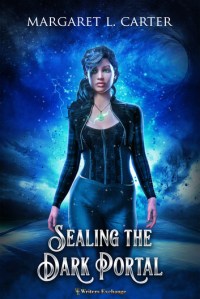
Margaret L. Carter: From the opening scene of my contemporary dark fantasy Sealing the Dark Portal (https://writers-exchange.com/sealing-the-dark-portal/):
Nightmares belonged in the bedroom. So when Rina glimpsed a tendril of shadow writhing at the edge of the library’s parking lot, she knew something was wrong. She grabbed her friend’s arm.
“Whoa, you okay?” From behind her gold-rimmed glasses, Patricia Doyle followed the direction of Rina’s gaze. “It’s just Mr. Rodriguez.”
Of course it wasn’t the oil slick monster from Rina’s dreams. The shape she had imagined she’d seen morphed into a man in his sixties wearing his usual faded jeans and shabby denim jacket. He shuffled out of the shadows onto the pavement. She unclenched her grip, and her shoulders sagged.
“Why so jumpy?” Pat asked. “You’re the one who used to have the idiotic habit of walking home alone after dark.”
Rina didn’t want to mention the revival of the nightmares she thought she’d smothered months before. Never mind walking home — if she raved about dark tentacles coiling around her, she would sound too unstable to drive.
CC: How can we get in touch with you or find your work? Drop your links here!
Margaret L. Carter:
Website: Carter’s Crypt: http://www.margaretlcarter.com
My monthly newsletters can be found here: https://www.margaretlcarter.com/newsletters/
Facebook: https://www.facebook.com/margaret.carter.18
Goodreads: https://www.goodreads.com/margaretlcarter
Thank you, Margaret L. Carter, for such an informative and thoughtful interview. I am linking the book you recommended above here: First Draft in 30 Days, by Karen S. Wiesner. As a recovering pantser who’s trying to plot more, I can’t wait to read this resource and get myself more organized. I appreciate you sharing your love of writing and books, and I look forward to seeing more from you in the near future!
Brava and as always, keep reading, writing, and creating!
Celaine Charles
May 5, 2026

Bio:
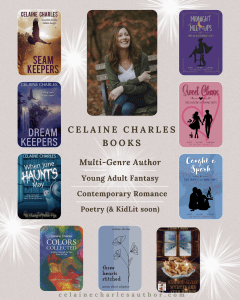
Celaine Charles is a teacher by day and writer by night. She’s an award-winning, multi-genre author who strives to balance her dual life creating poetry, young adult fantasy, romance shorts, and a blog about her writing journey, Steps in Between. To thrive, Celaine enjoys walks through the enchanted forests of Washington State, reading at least fifteen minutes a day, and eating mounds of allergy-free chocolate. She is currently querying her children’s picture books about social emotional learning. Join her newsletter, as she loves connecting with writers and readers. Find her other published books and links on her website:https://celainecharlesauthor.com/
P.S. Have you subscribed to my free monthly author’s newsletter? I would love to connect with you!https://dashboard.mailerlite.com/forms/93468/59834689879278649/share
P.S.S. If you’ve read any of my books and enjoyed them, I would be ever grateful for a short, positive review on Amazon, Goodreads, Barnes & Noble, BookBub and/or the like. Reviews help smaller authors like me get noticed more, providing opportunities to bring you more books. Thank you in advance!
Let’s Connect!
(Newsletter)https://dashboard.mailerlite.com/forms/93468/59834689879278649/share
(Author Website)https://celainecharlesauthor.com
(Instagram)https://www.instagram.com/cc_celainecharles
(Facebook)https://www.facebook.com/profile.php?id=100020278358757
(Linktree)https://linktr.ee/celainecharles
Categories: fiction, Thoughts on writing...
Tags: #authorinterview, #authortips, #authortoauthor, #CCsInterviewSeries, #fantasyfiction, #horror, #paranormalromance, #readingcommunity, #Thehauntingofpinedalehigh, #vampirebooks, #writingcommunity, #wrpbks

